1984. Dir: Tian Zhuangzhuang.
Lu Tonglin: "Tian’s minority film, On the Hunting Ground (Liechang zasa, 1984), bears an astonishing resemblance to documentary. At first, the Mongolian language was not translated into Mandarin, although the film addresses a specific Han audience, familiar with film culture and completely alien to this language. Due to objections from reviewers, Tian unwillingly added the offscreen voice of a male interpreter, who translates male and female, old and young voices with an equally monotonous tone. Like the title, written in the Mongolian language, the Mongolian culture in the film is objectified through this impassive voice, which serves mainly as a signifier of something more significant: the Han culture. Tian claimed that he was interested only in the Han Chinese society while making minority films.3 Furthermore, this documentary quality is also put in question by the very title of the film: Liechang zasa, a hybrid combination of Mandarin and Mongolian, means rules (zasa in Mongolian) on the hunting ground (liechang in Mandarin). Despite the documentary appearance, these rules are fictional in contemporary Inner Mongolia, since collective hunting activities are themselves inventions of the filmmaker in this specific geographical and historical location."
"The introductory shot of ruins of ancient palaces gives these rules an origin: the Mongolian nation as unified by Genghis Khan. In the following scene, a group leader on the hunting ground, Jirguleng, explains these rules in detail to other hunters. His explanations provide these rules with a hybrid nature by combining ancient Mongolian culture and current Chinese state policy. The first rule – a hunted animal belongs to the owner of the dog that first grasps it – seemingly has its origin in ancient times, since it appears free of any current political implication. By contrast, the two other rules – the care of childless aged people and the prohibition of shooting at state-protected animals – appear to belong to the era of the People’s Republic of China, because they use a contemporary politicized vocabulary. By combining supposedly ancient Mongolian rules with those of contemporary China, the film suggests that these apparently exotic rules do not separate the Mongolian community in the film from the political reality of the Han Chinese audience."
"The story line is deceptively simple and sketchy. Against the rule, a hunter named Wangenzabu takes possession of a deer that was first grasped by the dog of Bayasiguleng, a hunter from a neighboring village. By chance, a passerby happens to witness his transgression and reports it to the legitimate owner. Bayasiguleng angrily reports the thievery to Wangenzabu’s village chief, Jirguleng. As a result, according to a traditional ritual of punishment, Wangenzabu’s mother publicly whips her transgressive son and forces him to kneel down until next morning in front of a tree trunk to which the deer head is nailed. Wangenzabu’s public humiliation angers his elder brother Taogetao, the manager of the cooperative shop, and triggers a series of vengeful acts against Bayasiguleng. The animosity between the two men intensifies to the point that, armed with sickles and knives, men in the two neighboring villages almost battle over the use of a piece of grassland. Moreover, this animosity also destroys the male bonding between Wangenzabu and Jirguleng, although the latter just saved his former friend from a wolf den at risk of his own life. At the end the film, partly through the intervention of their wives, the male community of Mongolian hunters finally reconcile by kneeling down one after the other in front of the tree trunk."
"Tian’s film endows the dual nature of this law with a universal flavor by reminding audiences what happened recently in their own society – that is, mainstream Han society. During the Cultural Revolution, self-contradictory political rules often led to destruction of traditional human ties, as did zasa in the Mongolian hunting community. These rules engendered conflicts among neighbors, former friends, and close family members by pitting them against each other, while triggering selfishness in human beings by promising rewards or promoting fear. One can see the story of the fictive Mongolian hunting rule as an allegory of recent Chinese social history."
Showing posts with label Film. Show all posts
Showing posts with label Film. Show all posts
Friday, 1 July 2016

Monday, 18 May 2015
Ermo (Film)
1994. Dir: Zhou Xiaowen.
Context:
Economic reforms during the Deng era led to more consumerist desire for material goods. The 'Responsibility System' put in place and adopted by 90% of peasant families, led to increased production and more buying power for peasants, stimulating demand for consumer commodities, like TV sets and so on...
The Film:
"Zhou shares Zhang Yimou’s interest in sexuality and rural life, but has a darker sense of humor. This is an underseen masterpiece, apparently never released on a DVD with English subs (though there are laserdisc rips floating around). Ermo is a rural woman who has a fierce rivalry with her neighbor. The neighbor gets a TV, so Ermo decides that they must get a TV too, but a bigger one. To raise the money, Ermo begins making noodles at night, eventually traveling into the city to sell them. She also starts an affair with her neighbor’s husband, who makes frequent trips into the city. Zhou’s tone is at once serious and satirical, sighing over changing values in Chinese society as it mocks them. It’s also relatively light on policing adultery, and Zhou films the noodle-making scenes with a sensuality not unlike sex scenes. While Zhang’s rural films are mixed with nostalgia and criticism of the past, this film takes a darkly comic look at their modern descendants." - http://www.criterionforum.org/forum/viewtopic.php?f=24&t=13398&start=225#p506931
Reception:
The film won a prize at Locarno Film Festival.
Zhou Xiaowen, who in the 1980s was making more urban films, seems by 1994 and with this film to be catering more towards the international appetite for the accepted 5th Generation 'style', and makes a rural film, with a female central character. In a 1994 interview Zhou himself admits that this shift had something to do with trying to replicate the success of more international celebrated 5th Generation directors.
Resources:
https://www.youtube.com/watch?v=cAc7sMiNGYY
https://www.youtube.com/watch?v=YKXTsq0ExPQ
http://www.ejumpcut.org/archive/onlinessays/JC42folder/Ermo.html
Context:
Economic reforms during the Deng era led to more consumerist desire for material goods. The 'Responsibility System' put in place and adopted by 90% of peasant families, led to increased production and more buying power for peasants, stimulating demand for consumer commodities, like TV sets and so on...
The Film:
"Zhou shares Zhang Yimou’s interest in sexuality and rural life, but has a darker sense of humor. This is an underseen masterpiece, apparently never released on a DVD with English subs (though there are laserdisc rips floating around). Ermo is a rural woman who has a fierce rivalry with her neighbor. The neighbor gets a TV, so Ermo decides that they must get a TV too, but a bigger one. To raise the money, Ermo begins making noodles at night, eventually traveling into the city to sell them. She also starts an affair with her neighbor’s husband, who makes frequent trips into the city. Zhou’s tone is at once serious and satirical, sighing over changing values in Chinese society as it mocks them. It’s also relatively light on policing adultery, and Zhou films the noodle-making scenes with a sensuality not unlike sex scenes. While Zhang’s rural films are mixed with nostalgia and criticism of the past, this film takes a darkly comic look at their modern descendants." - http://www.criterionforum.org/forum/viewtopic.php?f=24&t=13398&start=225#p506931
Reception:
The film won a prize at Locarno Film Festival.
Zhou Xiaowen, who in the 1980s was making more urban films, seems by 1994 and with this film to be catering more towards the international appetite for the accepted 5th Generation 'style', and makes a rural film, with a female central character. In a 1994 interview Zhou himself admits that this shift had something to do with trying to replicate the success of more international celebrated 5th Generation directors.
Resources:
https://www.youtube.com/watch?v=cAc7sMiNGYY
https://www.youtube.com/watch?v=YKXTsq0ExPQ
http://www.ejumpcut.org/archive/onlinessays/JC42folder/Ermo.html
Thursday, 5 February 2015
Farewell My Concubine (Film)
Ba wang bie ji. 1993. Dir: Chen Kaige.
Context:
Based on a novella by Hong Kong writer Lilian Li. Previously adapted for TV by Alex Law in Hong Kong, in 1982. (That version was more faithful - see Stanley Kwan's doc for brief details)
In some ways reminiscent, even influenced by, Xie Jin's 'Two Stage Sisters': "Two Stage Sisters features the story of the relationship between two Shaoxing opera performers from their beginnings as itinerant entertainers in the feudal countryside of 1930s China through success in Shanghai during the Japanese occupation, eventual separation, and reunion during the post-Revolutionary period. Changes in the style of the operas presented in the film (for example, folk opera, Western-influenced critical realist operas, Mao’s favored ‘‘revolutionary romanticism’’ in opera form) also parallel broader social and political changes."[International Dictionary of Directors]
The Film:
Reception:
Context:
Based on a novella by Hong Kong writer Lilian Li. Previously adapted for TV by Alex Law in Hong Kong, in 1982. (That version was more faithful - see Stanley Kwan's doc for brief details)
In some ways reminiscent, even influenced by, Xie Jin's 'Two Stage Sisters': "Two Stage Sisters features the story of the relationship between two Shaoxing opera performers from their beginnings as itinerant entertainers in the feudal countryside of 1930s China through success in Shanghai during the Japanese occupation, eventual separation, and reunion during the post-Revolutionary period. Changes in the style of the operas presented in the film (for example, folk opera, Western-influenced critical realist operas, Mao’s favored ‘‘revolutionary romanticism’’ in opera form) also parallel broader social and political changes."[International Dictionary of Directors]
The Film:
- .The complex story of the friendship between two Peking Opera stars (Leslie Cheung and Zhang Fengyi) spanning five decades of tumultuous Chinese history.
- Politics/history as stage/performance/opera metaphor. People had to act/perform to stay alive in front of the eyes of the outside world, always trying to ensure citizens were 'good communists', and had to publically denounce others during the Cultural Revolution, hence paranoia and the dissolved line between performance and authenticity. Opera (and performance) of course also ties in with Jiang Qing (Madame Mao) and her influence/censorship during the Cultural Revolution. Opera then was a battleground between banned titles and state-accepted titles, which were decided by Jiang.
- See: http://www.criterionforum.org/forum/viewtopic.php?f=24&t=13398&start=225#p506931
Reception:
- .
- Banned in Taiwan (verify) due to having too many mainland Chinese actors, thereby breaking regulations.
Sunday, 19 October 2014
Life on a String (Film)
1991. Dir: Chen Kaige.
Context:
British-Japanese-Dutch-German-Italian coproduction...
The Film:
References:
http://nasharit.ru/video?name=idi_i_poi_/_zhizn_na_strune_/_Life_on_a_String_/_Bian_Zou_Bian_Chang&site=vk&oid=22687267&id=159509512&hash=77673485938ddeb4
http://v.youku.com/v_show/id_XNTQ0MzY2NzY=.html
Context:
British-Japanese-Dutch-German-Italian coproduction...
The Film:
- "My favorite Chen film of the decade, closer to the quiet, tragic beauty of Yellow Earth than the excesses of the later films. This, like Temptress Moon, is hard to follow at first, and assumes some knowledge of Chinese tradition and folklore. There’s also an odd restaurant surrounded by waterfalls that may or not be some metaphysical waystation between this world and the next. The plot follows an old blind musician who wanders around rural northern China, regarded as a holy man by the locals. According to some custom, if a blind musician breaks 1000 strings during his lifetime, he will be able to regain his sight. The old man has a young protégée, who occasionally rages at his blindness and wants to see. The young man falls in love with a local girl, but trouble arises with her parents. Gradually, it’s revealed that while the old man has tried to put love and the desire to see behind him, he still feels tormented by lost love and the promise that his eyesight may return, causing conflict with the young man. Throughout a mysterious figure, who resembles a statue of a God of Death in the temple where the two live, appears in crowds watching the players perform, grinning mysteriously. While the colors don’t pop as much as in Yellow Earth, there are still lots of lovely landscape shots. Appreciation of this film may depend a lot on what you make of the two big sequences where the old man sings (to stop a fight between two villages, and at the end), and your ability to accept its many ellipses that are never quite filled." [CriterionForum, 1990s list thread, Feb 2015]
References:
http://nasharit.ru/video?name=idi_i_poi_/_zhizn_na_strune_/_Life_on_a_String_/_Bian_Zou_Bian_Chang&site=vk&oid=22687267&id=159509512&hash=77673485938ddeb4
http://v.youku.com/v_show/id_XNTQ0MzY2NzY=.html
Friday, 17 October 2014
The Big Parade (Film)
1986. Dir: Chen Kaige. Cin: Zhang Yimou. Scr: Gao Lili.
Context:
"Director Chen Kaige, cinematographer Zhang Yimou and designer He Qun started work on The Big Parade almost as soon as they had finished Yellow Earth. The film was shot in the spring and summer of 1985 and it went into post-production the normal way in the autumn. It had reached fine-cut stage by November, when the PLA took strong objection to it. Chen Kaige initially refused to modify the film in any way and so it lay substantially complete but unreleasable for nearly a year. Chen finally agreed to make various changes, purely for the sake of his producers at Guangxi Film Studio, to whom he was of course indebted for his break as a director." [Tony Rayns, Monthly Film Bulletin 1988]
Resources:
http://www.ntnu.edu.tw/tcsl/Media_Language/kaige/filmography/dayuebing.html
http://nasharit.ru/video?name=bolshoi_parad_/_The_Big_Parade_/_Da_yue_bing_(_1986_/1987_)_rezh._chen_kaige_/_Chen_Kaige&site=vk&oid=-21996785&id=164879576&hash=1c7d2195ae8a369a
http://www.nytimes.com/1987/07/12/magazine/china-s-cultural-crackdown.html (Contemporary review)
Context:
"Director Chen Kaige, cinematographer Zhang Yimou and designer He Qun started work on The Big Parade almost as soon as they had finished Yellow Earth. The film was shot in the spring and summer of 1985 and it went into post-production the normal way in the autumn. It had reached fine-cut stage by November, when the PLA took strong objection to it. Chen Kaige initially refused to modify the film in any way and so it lay substantially complete but unreleasable for nearly a year. Chen finally agreed to make various changes, purely for the sake of his producers at Guangxi Film Studio, to whom he was of course indebted for his break as a director." [Tony Rayns, Monthly Film Bulletin 1988]
Resources:
http://www.ntnu.edu.tw/tcsl/Media_Language/kaige/filmography/dayuebing.html
http://nasharit.ru/video?name=bolshoi_parad_/_The_Big_Parade_/_Da_yue_bing_(_1986_/1987_)_rezh._chen_kaige_/_Chen_Kaige&site=vk&oid=-21996785&id=164879576&hash=1c7d2195ae8a369a
http://www.nytimes.com/1987/07/12/magazine/china-s-cultural-crackdown.html (Contemporary review)
Monday, 29 September 2014
Saturday, 20 September 2014
The Blue Kite (Film)
1993. Dir: Tian Zhuangzhuang.
The Film:
Lu Tonglin: "The film, mainly based on the life story of a boy from Beijing named Lin Dayu or Tietou (Iron Head), presents the world from his perspective. Along with his mother, Tietou lives through the most important political movements in the history of Communist China, that is, the Anti-Rightist Campaign in 1957, the Great Leap Forward in 1958, and the Cultural Revolution in 1966. His mother, Chen Shujuan, loses her three successive husbands during these political movements. Tietou’s father, Lin Shaolong, sent to a labor camp in a border region as a rightist, is killed by a falling tree while chopping wood. His “uncle,” Li Guogdong, falls in love with his mother partly out of guilt (during the Anti-Rightist Campaign he had reported his private conversation with Lin and another friend). Soon after his marriage to Shujuan, Li dies of liver failure partly due to malnutrition caused by “three years of natural disaster” – a convenient name for the economic disaster caused by the Great Leap Forward. Tietou’s later stepfather, Wu, suffering from severe heart disease, dies during the Cultural Revolution after humiliation and torture at the hands of Red Guards. The film is divided into three segments, each of which has a title written in a childish hand: “father,” “uncle,” and “stepfather” – successive fathers for the protagonist. Despite its highly subjective perspective, Blue Kite, like the two minority films, reveals a concern with one fundamental problem: individuals facing a powerful social institution."
"Furthermore, from 1986, the year he made Horse Thief, to 1993, the year for Blue Kite, Fifth Generation filmmakers underwent radical changes. On the Hunting Ground and Horse Thief were sponsored by the stateowned studios Inner Mongolian and Xi’an in the mid-1980s. At the beginning of the open-door reformist policy, Xi’an Studio was famous for its support for formal innovations. In this context, box-office failure would not greatly effect the financial situation of the filmmaker’s socialist “iron bowl.” By 1992, since the film industry in China had become market-oriented, box-office value had become predominant in measuring a film’s success or failure. At the same time, well-known Fifth Generation directors started seeking investments from multinational corporations. In this case, their works depended even more on commercial success in a global market. Understandably, the antinarrative and experimental tendency in Tian’s minority films can no longer survive in the new world. Since the relative commercial success of Zhang Yimou’s first three movies in the international market, most Fifth Generation directors have multiplied their efforts to make conventional narrative films, often by re-creating eroticized and suffering images of Chinese female beauties in the early 1990s. In this respect, Tian’s Blue Kite bears many characteristics of its time. Nevertheless, Tian followed the Zhang Yimou model31 more discreetly than most of his colleagues – such as Chen Kaige, for example, who wholeheartedly embraced this model in his Farewell My Concubine (1993) and Temptress Moon (1996). Although Tian’s film was forbidden in China, ironically, it was one of the few films made by Fifth Generation directors during this period that tried genuinely to address the Chinese audience despite its focus on the global market. Unlike most films in the Zhang Yimou model, Blue Kite avoided ritualizing Chinese tradition."
Reception:
Distribution: Kino International (US theatrical and home video); UGC Distribution (France theatrical).
The Film:
Lu Tonglin: "The film, mainly based on the life story of a boy from Beijing named Lin Dayu or Tietou (Iron Head), presents the world from his perspective. Along with his mother, Tietou lives through the most important political movements in the history of Communist China, that is, the Anti-Rightist Campaign in 1957, the Great Leap Forward in 1958, and the Cultural Revolution in 1966. His mother, Chen Shujuan, loses her three successive husbands during these political movements. Tietou’s father, Lin Shaolong, sent to a labor camp in a border region as a rightist, is killed by a falling tree while chopping wood. His “uncle,” Li Guogdong, falls in love with his mother partly out of guilt (during the Anti-Rightist Campaign he had reported his private conversation with Lin and another friend). Soon after his marriage to Shujuan, Li dies of liver failure partly due to malnutrition caused by “three years of natural disaster” – a convenient name for the economic disaster caused by the Great Leap Forward. Tietou’s later stepfather, Wu, suffering from severe heart disease, dies during the Cultural Revolution after humiliation and torture at the hands of Red Guards. The film is divided into three segments, each of which has a title written in a childish hand: “father,” “uncle,” and “stepfather” – successive fathers for the protagonist. Despite its highly subjective perspective, Blue Kite, like the two minority films, reveals a concern with one fundamental problem: individuals facing a powerful social institution."
"Furthermore, from 1986, the year he made Horse Thief, to 1993, the year for Blue Kite, Fifth Generation filmmakers underwent radical changes. On the Hunting Ground and Horse Thief were sponsored by the stateowned studios Inner Mongolian and Xi’an in the mid-1980s. At the beginning of the open-door reformist policy, Xi’an Studio was famous for its support for formal innovations. In this context, box-office failure would not greatly effect the financial situation of the filmmaker’s socialist “iron bowl.” By 1992, since the film industry in China had become market-oriented, box-office value had become predominant in measuring a film’s success or failure. At the same time, well-known Fifth Generation directors started seeking investments from multinational corporations. In this case, their works depended even more on commercial success in a global market. Understandably, the antinarrative and experimental tendency in Tian’s minority films can no longer survive in the new world. Since the relative commercial success of Zhang Yimou’s first three movies in the international market, most Fifth Generation directors have multiplied their efforts to make conventional narrative films, often by re-creating eroticized and suffering images of Chinese female beauties in the early 1990s. In this respect, Tian’s Blue Kite bears many characteristics of its time. Nevertheless, Tian followed the Zhang Yimou model31 more discreetly than most of his colleagues – such as Chen Kaige, for example, who wholeheartedly embraced this model in his Farewell My Concubine (1993) and Temptress Moon (1996). Although Tian’s film was forbidden in China, ironically, it was one of the few films made by Fifth Generation directors during this period that tried genuinely to address the Chinese audience despite its focus on the global market. Unlike most films in the Zhang Yimou model, Blue Kite avoided ritualizing Chinese tradition."
Reception:
Distribution: Kino International (US theatrical and home video); UGC Distribution (France theatrical).
Monday, 8 September 2014
A Girl from Hunan (Film)
Xiang nu xiao xiao. 1986. Dir: Xie Fei.
Based on story by Shen Congwen, a famed Chinese veteran writer whose work often critiqued old traditionalist Chinese ways of life.
Based on story by Shen Congwen, a famed Chinese veteran writer whose work often critiqued old traditionalist Chinese ways of life.
Friday, 22 August 2014
King of the Children (Film)
 Haizi wang. 1987. Dir: Chen Kaige. Scr: Chen Kaige, Wan Zhi (aka Chen Maiping), He Jianjun(?).
Context:
Based on story by Ah Cheng, with whom Chen had spent his zhiqing days, working together in a rubber plantation during the Cultural Revolution.
It was Chen's first film to be produced at Xi'an Film Studio, under the wings of Wu Tianming, having moved from Guangxi Film Studio and his collaborator Zhang Yimou (who would himself soon make the move from cinematographer to director).
Reportedly Chen re-edited the film after seeing Hou Hsiao-Hsien's Dust in the Wind, and gave the rhythm an even more impressionistic feel. [Cheshire, Film Comment 1992]
 The Film:
Relation to ideas about Chinese culture: "Chen does not attach to copying the value of a positive meaning as does Ah Cheng; rather in it he sees the contemporary Chinese culture's deconstruction of traditional Chinese culture. For Chen, the destructiveness of the Cultural Revolution is not an accident but the summation of the Chinese civilisation, and the act of copying, to which the students are reduced, signifies the emptiness of culture itself." [Rey Chow, Primitive Passions, 120]
Reception:
Distribution: ICA (UK theatrical, 1988); Orion Classics (US theatrical).
References:
http://alsolikelife.com/shooting/2009/05/967-109-hai-zi-wang-king-of-the-children-1987-chen-kaige/
http://worldcinemadirectory.co.uk/component/film/?task=view&id=1154
"The Pain of a Half Taoist" - an Jingfu, CInematic Landscapes pp117-125
Friday, 15 August 2014
Black Snow (Film)

Context:
The film's urban setting and handheld camerawork differentiates it from Xie's other, rural/province-set work and its tranquil smooth stylistics.
The Film:
Reception:
Winner of Silver Bear at the Berlin Film Festival.
Ju Dou (Film)

Context:
Based on short story by Liu Heng (link to a translation below).
Zhang's CR experience of labour in a textile factory can be seen as informing some parts of this film.
The Film:
Zhang makes typical use of eye-popping colour cinematography, especially helped by several set pieces with the colour dyes.

It is possible to read the film's plot in many ways, including on Freudian terms, but also allegorically: the cruel old man might represent Confucianist traditions, and the blank-faced seemingly intrinsically evil boy the more modern Maoist dictatorship and the Cultural Revolution (in which of course Mao encouraged the youths to commit the anarchic revolts he was after). The central couple are then torn between these two miserable options.
Reception:

References:
http://www.clockwatching.net/~vroom/zyimou.html
http://www.filmsufi.com/2012/09/ju-dou-zhang-yimou-and-yang-fengliang.html
http://www.academia.edu/9192367/Liu_Heng_Dogshit_Food_trans._Sabina_Knight (Original story)
Thursday, 14 August 2014
The Horse Thief (Film)

Context:
Wu Tianming at Xi'an Film Studio was aggressively purchasing novel rights at this time when he sought rights for this novel by Zhang Rui. Zhang then informed Wu that he and Tian Zhuangzhuang had already penned a screenplay (shortly after Tian made On the Hunting Ground) and that if he wanted to make it a film Tian had to direct it. Wu agreed to this.
During this time the Chinese censors still forbade the use of any dialects for film dialogue and so they asked for the film to be dubbed into Mandarin. This Mandarin dubbed version became the standard version in China, but the original Tibetan soundtrack was able to be rescued for the French and US releases.
The Film:
Lu Tonglin: "The film portrays the life of a Tibetan named Norbu and his family. Although its story line is seemingly stronger than that of On the Hunting Ground, Horse Thief challenges its viewers more because most of its religious scenes are often loosely related, if not unrelated, to the diegetic world. Taking into consideration the great proportion of religious scenes, the film develops almost on two separate fronts: a feature on Norbu and his family, and a documentary on Tibetan religious rituals."
"This film presents the life of Norbu, a Tibetan living on the margins of the Qinghai Province during the 1920s and relying on horse thievery to support his family. Because he robbed several Muslim messengers of governmental gifts for a temple, Norbu and his family are expelled from the tribe by the headman. Partly due to hardship in exile, his two-year-old son Tashi falls ill. Despite all their prayers, Norbu and his wife Dolma fail to save their son’s life. After burying his body in the snowy land, Norbu and Dolma start a long and strenuous pilgrimage journey, by the end of which his wife has become pregnant. Since Norbu believes that his first son’s death results from a divine punishment, he decides to steal no longer. In order to keep his promise, the horse thief is reduced to the lowest job, serving as a surrogate for the evil river ghost in a religious ritual, which no one else would do despite its financial incentive. (Even the actor playing Norbu was reluctant to perform this role, as he was afraid of contempt from his community.) As a result of his job, the tribe is even more determined to refuse Norbu’s plea for a possible return. As worse comes to worst, Norbu is forced to sell his beloved horse, which until this point has followed him everywhere. Afterward, he returns to its new owner’s tent to bring his horse some food for the last time and bid the animal farewell. Taken as a horse thief again, he is severely beaten by the new owner. On a stormy night, Norbu sends his wife and the child away on the back of a stolen horse in order to save the life of his newborn son, while he himself commits suicide in front of the tower of sky burial."
"The film presents three sequences of sky burial, often using exactly the same footage, each one closer than the last to the hero of the narrative world, Norbu. In the introductory sequence, the sky burial for an unknown individual offers a seemingly universal version of this religious ritual. Then, in the middle of the film, from Norbu’s impassive perspective, the film presents the sky burial of the headman’s father. Norbu himself is excluded from the ritual, and his gift has been disdainfully rejected by the headman because it came from an impure source, his thievery. As a result, as an unwelcome intruder, Norbu sits alone, watching the ceremony from a distance. Granny and the father of Norwe, another horse thief, earlier spoke of their belief that sacred hawks would send the soul of the headman’s father to heavens by eating his flesh. However, they believe, since Norbu and Norwe sin against heaven through thievery, the divine birds will certainly refuse to eat their bodies after their death; hence their souls will never be able to reach the heavens. As if to contradict this prediction, in the last sequence the image of Norbu’s dagger, drenched in blood and abandoned on the snowy ground, suggests his suicide near the tower of sky burial. Presumably, hawks perform their duty of sky burial for the horse thief, although monks, unlike in the two previous scenes, are conspicuously absent. Norbu’s implied suicide near the tower deliberately challenges the common faith in his community according to which a former horse thief is not entitled to sky burial – as Granny explained earlier. At the same time, this challenge is also an expression of unshakable faith in religious salvation."
Reception:
Distribution: International Film Circuit (US Theatrical and home video, 1988)
Joris Ivens recommended it to Bertolucci, then in China making The Last Emperor. Bertolucci suggested to Tian that he submits it to the Venice Film Festival, but Tian back then had no idea how to do that or even what the festival was...
Sight&Sound review 1987 (Stanbrook): compares to Paradjanov (can some of M. Makhmalbaf's films be too?)
References:
http://worldcinemadirectory.co.uk/component/film/?task=view&id=1173
The Black Cannon Incident (Film)
Context
The film is often seen as a post-socialist satire on the state of things during the Deng reform era. The ineffectual intellectual (the protagonist) associated with the desire for progress is held back by the remnants of a bureaucracy which cannot go away.
The film can also be seen as a subversion of the spy genre common in the 1950s, which was a reflection of that era's national security fears and paranoia (see essay in Chinese Films in Focus).
The Film
- A kind of postsocialist reworking of the famous literary work ‘Story of Ah Q’, it satirises the regime more deeply than any film reviewers dared admit at the time.
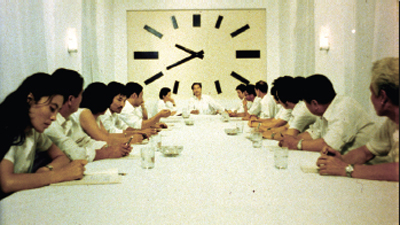
- The sets, especially the all-white symmetric conference room with the absurdly giant clock overlooking everyone, are distinctly modernist rather than realist. This room should typically feel safe and imbued with a benevolent authority linked to the Party, yet this coldness and absurdity makes it feel totally different.
- The affable and honest German engineer Hans Schmidt is seen as perplexed and confused by the backstage intrigues and paranoia of his Chinese hosts --- a subversion of the role of the foreigner, typically the malevolent instigator of an external threat, in the spy film genre during the Maoist period.
- The 360-degrees pan at the end (also circularity of other scenes and objects like the spinning ball-bearing, the chess piece itself and its container substitute).... Huang linked it to the concept of a 'Strange Loop' (Hofstadter), a bit like a Mobius strip. In the end everything is back where it started, because the 'threat', the black cannon, was non-existent.
Reception
Resources:
Essay by Pickowicz on Huang Jianxin's trilogy + essay by Farquhar and Berry in 'Cinematic Landscapes/
Sunday, 3 August 2014
The One and the Eight (Film)
 Yige he bage. 1983. Dir: Zhang Junzhao. Cinematography: Zhang Yimou.
Context:
Produced at Guangxi Film Studio. Based on an epic poem.
The Film:
This is a film which uses film language (cinematography, framing compositions, depth of field) to get across its meaning - dialogue is often sparse. For instance, in the first act of the film when the nine men are in jail: the 'one' is typically framed on his own (and also asymetrically, not in the centre of the frame) - this is a strong individual assured in his principles despite accusations against him. The 'eight' on the other hand are often cramped together, sometimes as many as 4 or 5 in the same frame - they are a group, a collective, but not a cohesive, unified one, they are essentially a rabble and clearly guilty of the charges against them. The 'one' is thus privileged as the hero of the piece, and his strong individual personality is put to the forefront, while the 'eight' are essentially weak men, confused at best, cowardly at worst. In this simple dichotomy of individual vs. collective, of conformity vs. non-conformity can perhaps be read a radical rejection of fundamental CCP doctrines, or at the very least of the paranoid purges of the Cultural Revolution.
The film, after an opening credits montage with voiceover narration introducing the historical context, begins on a shot of earth before tilting upwards to fill the frame with sky. This cinematography announces Zhang Yimou's style, which he'd use to even greater effect in Yellow Earth, a film in which the visual dichotomy between the land and the heavens plays a major role.
Reception:
The film was met with censorship issues, as the Film Bureau objected to the depiction of the falsely accused Communist officer and his treatment at the hand of his own party. The film was also criticised for supposedly downplaying the role ofthe Communist army during the Second Sino-Japanese War (1937-45), essentially undermining the romantic myths which the ruling CCP aimed to foster about the past.
Changes were demanded of the film before it could be released, which eventually happened after the release of Yellow Earth - meaning that the latter was the first film to have impact and influence on Chinese film in the '80s. These changes included cuts as well as completely re-shot scenes. The revised version thus altered much of the film's original meaning. Domestically it then went on to some small commercial success, but internationally was banned from export until 1987.
Ni Zhen: "This change [in film style/language] was not an attack on their predecessors, however, but a natural evolutionary consequence of the growing sense of cinematic specificity --- as well as individual identity --- in the 1980s."
References:
Rayns, Perspectives on Chinese Cinema, 108.
https://cinescopeblog.wordpress.com/2014/09/23/the-chinese-new-wave-the-one-and-the-eight-1983/
Sunday, 27 July 2014
Raise the Red Lantern (Film)
1991. Dir: Zhang Yimou. Scr:. Cin: Zhao Fei.
Context:
The Film:
Reception:
References:
https://film110sp12.pbworks.com/w/page/52547203/Color%20and%20Power%20in%20Raise%20the%20Red%20Lantern
http://www.clockwatching.net/~vroom/zyimou.html
Context:
The Film:
Reception:
- Raise the Red Lantern was one of the rare Chinese films successfullymarketed in America and its success has been ascribed to its exotic formula.
- Zhao Fei won the NSC award in 1992 for his cinematography on this film.
- Criticed by, amongst others, Dai Qing for supposedly pandering to Orientalist tastes. Contesting this kind of critical reception, Rey Chow proposes that they might be better understood in terms of a self-reflexive or 'autoethnographic' gaze. Ethnography is a sociological methodology, involving the mapping of a regional group's social practices and customs, traditionally undertaken by colonial or 'Western' outsiders. Chow suggests that filmmakers like Zhang Yimou have undertaken the role of 'autoethnographers', allowing the Chinese to gaze at themselves at the moment of their international emergence.
References:
https://film110sp12.pbworks.com/w/page/52547203/Color%20and%20Power%20in%20Raise%20the%20Red%20Lantern
http://www.clockwatching.net/~vroom/zyimou.html
Wednesday, 16 July 2014
Red Sorghum (Film)
 1987. Dir: Zhang Yimou.
Context:
- Zhang speaking about the film: "My personality is quite the contrary to the mood of the film, I have long been repressed, restrained, enclosed and introspective. Once I had a chance to make a film on my own, I wanted to make it liberated, abandoned."
- Yuejin Wang writes: "In the early 1980s, the speculation on the past, on our cultural history, and on the structure of the Chinese mentality, led to a radical change in taste… average theatregoers became fascinated by the charisma of ‘tough guys’ in Japanese and Western movies …Red Sorghum is a cinematic milestone that proposes a powerful Chinese version of masculinity as a means of cultural critique" and "Red Sorghum and many other culturally specific texts do not reflect the appearances of a culture; they mirror what the actual cultural landscape lacks. They reflect fantasies and imagined memories – that which society expels." and "Red Sorghum echoes certain motifs recurrent in the literary ‘search for roots’ that surged in China in the early and middle 80s. Set in an imagined faraway, long ago world where naked human existence is … crude… this new literary genre has as one of its leitmotifs the poetic celebration of masculine potency…. Masculine potency becomes therefore a figure of coming into one’s own being, of spiritual independence of authorial power". These quotes offer up illuminating ways of looking at the films of Zhang, and their perceived over-stylised aesthetics as part of 'fantasies and imagined memories'. A fractured past needs reinventing in order for culture to start again, leading to a real re-evaluation of culture, identity and past. Hence also the connection between this film and the literary root-searching movement, which also tried to look deeper into the past for a revived sense of culture and identity.
The Film:
- Yuejin Wang argues for a gendered reading of the film. Elements based around masculinity are described above, while the early red sedan scene is argued to be shot from a 'female gaze' perspective with Gong Li's character checking out the male kidnapper's body and the camera following her gaze in POV.
Reception:
- Distribution: New Yorker (US theatrical and home video, 1988)
- The film had a controversial reception in China, where it was seen as too coarse and unrestrained (in its depictions of illicit sex, forwardness, violence…) and lacking in traditional Confucian values of restraint. This implies certain sections of the domestic audience saw it as 'un-Chinese'.
References:
Yuejin Wang essay in Perspectives on Chinese Cinema.
Yellow Earth (Film)
 Huang tudi. 1984. Dir: Chen Kaige. Scr: Zhang Ziliang. Cin: Zhang Yimou.
Context:
- Produced at Guangxi Film Studio after Chen asked to be transferred there to work with his friend Zhang Yimou, it was Chen's first feature film.
- Based on essay 'Echo in the Valley' by Ke Lan. This was a musical paean to the government and people, with a stereotypical story of an Eighth Route Army soldier bettering the life of a peasant girl by influencing her to struggle from the feudal traditions of her family (thereby emancipating her). The musical element in the film (i.e. the folk songs and recurring musical scenes of Cuiqiao's melancholy song over the river, overseen by pre-eminent composer Zhao Jiping) must be seen as stemming from this source, although it had no specific reference to the Northern China setting of Yellow Earth. A number of melodramatic and political clichés were dropped by Chen in his adaptation, which initially went under the working title 'Silent is the Ancient Plain', before the colour tones of the final result inspired a name-change.
- The film is a deconstruction of Communist mythology and propaganda: namely that their message spread like wildfire in the countryside, with peasants instantly being enthusiastic, as if the CCP and their message had a natural bond with them. The reality in Yellow Earth is shown to be vastly different, and the difficulties in bringing the Communist message to uneducated illiterate peasants, who are culturally steeped in ancient Confucianist beliefs and traditions, are shown to be deeply complicated.
- Chen, Zhang Yimou and other crew members scouted Shaanxi province, lived there with peasants for a month, and in the final film would recruit plenty of actual peasants and locals to star in roles or as extras. They would also include plenty of local 'colour', in the form of Shaanxi folk songs (xintianyou) and folk rituals. This would give the film an anthropological, documentary-esque film, although this was frowned upon by the official regime's views, presumably because they saw the film's portrayal of the rural population as clashing against their own propaganda of how they had made the peasants progressive and improved their lives.
- Technically the second 'Fifth Generation' film, it represents their efforts to disown and distance themselves from what came before them: propaganda films, didacticism, aged melodramatic styles. Chen Kaige said in an interview with Tony Rayns: "[The Fifth Generation graduates] shared two convictions: first, the older generation of Chinese filmmakers could be dismissed as propagandists, and second, film was an artistic medium that should be used personally. All of us hated what was passing for cinema in China – all that didacticism, all those dated, theatrical styles – and we set out determined to do something different and better." Such claims clearly sound like the words of a new generation of filmmakers starting what could be termed unde the label of 'new wave', as a cinematic movement.
- True to the Fifth Generation's ambitions to make a type of cinema completely different from previous Chinese films, its style and treatment of its content is very different to what came before in many respects. For instance, when compared with the many post-1949 films depicting feudal marriages, Yellow Earth can be seen as making a subtle comment on these films and their appropriation of such rituals for political rhetoric. E.g. Paul Clark states that one stock character from the 'model opera' type films during the C.R. was a "young woman eager to join the revolutionary struggle". Yellow Earth subverts this stock character.
- Like several other 1980s Fifth Generation films, it was shot in rural locations, specifically in the Shaanxi province just like Tian Zhuangzhuang's On the Hunting Ground, made the same year. Part of this interest with rural locales could be down to the directors' own experiences as zhiqing during the Cultural Revolution, to the greater ease and freedom (from the censorship and control of central regulations) they could enjoy working in such remote settings, and to bring to provide a cinematic portrait of/voice to some of the ethnic minorities of China.
The Film:
- Set in 1939, during the Sino-Japanese war (just as The One and the Eight had been, presumably because it is a safer era to touch on than any CCP era), in the rural parts Shaanxi province, with its parched yellow-ochre earth and by the banks of the Yellow River and also famously where Mao set up base after the Long March. Lao Gu (Wang Xueqi) is an Eighth Route Army (CCP) soldier on a mission to collate folk songs from the local peasants, in order to then turn them into Communist propaganda songs; it would both boost morales for the troops and presumably the goal is to also boost CCP support amidst these peasants. During this time Lao Gu is being housed by a poor family of farmers: a widower (Tan Tuo), his teenage daughter Cuiqiao (Xue Bai) and his young son Hanhan (Liu Qiang). The film however does not focus very much at all on Lao Gu's mission, or even that much on Lao Gu himself. Lao Gu as a central character works more as a focal and observational device, being our witness and guide to this harsh rural and feudal world (it must be noted that he has clearly far more modern values, as seen explicitly in his conversation with Cuiqiao's father concerning marriage). Lao Gu's role, as a relatively educated character from the city, sent to the rural backwards countryside in interaction with uneducated farmers/peasants, is easily read as a stand-in for the situations the zhiqing found themselves (including of course Chen himself the Yellow River. These traits should be seen as an attempt to directly and distinctly move away from the previous cinematic tropes of didacticism and melodrama.
- The parallels and contrasts between the film's two paternal figure - girl relationships (i.e. Father with Cuiqiao, and Lao Gu with Cuiqiao - representing respectively the relationship with/impact on of traditional confucianism and of communism on the population, both being impotent in improving lives) are key to its structure and meaning.
- Lao Gu's ineptitude and incapability to create any positive change to the fate of Cuiqiao (besides indirectly influencing her, he can do nothing as he cannot help her join the army before her marriage) can be seen as a reversal of the official version, where these peasants' lives were radically improved by the CCP and its soldiers.
- Aesthetic influences from pre-CCP classical culture: Its visual aspects and cinematography attempt to form a distinctly Chinese filmic language (as opposed to more conventional Western narrative filmic visual tropes) [c.f. Rey Chow describing the film's central dilemma as wanting to describe and comment on China with a technological medium and artform which the filmmakers were aware was 'non-Chinese' --- i.e. a cultural exchange of film technology and national culture]. In particular, the film has drawn comparisons to the non-perspectival tradition of Chinese scroll painting (long-shots of landscapes with dwarfed human figures, pans and tilts like the opening of scrolls, empty space, disproportionate horizons in the composition, etc), and to Taoist school of thought (the use of landscape is reminiscent of the Taoist dictum 'Silent is the Roaring Sound, Formless is the Image Grand'). From 'New Chinese Cinemas':"Yellow Earth’s reinsertion of nature into the coded semiotic system of Chinese film syntax, its reinterpretation of landscape and its strategy of emptying space constitute… the Daoist terms for the political reinstatement of a classical mode of the Chinese aesthetics". The peasants have a deep respect and understanding of nature (c.f. the father's respect for the land by ritually sprinkling grain on the revered yellow earth, which Gu laughs at and sees as supersition --- to him the earth is merely raw material to be exploited just like the folk songs are to the CCP, but to the peasants who work it, it offers livelihood and deserves deep respect, as do the folk songs --- and Yellow Earth also reflects that respect for both the earth and the folk songs and traditions) which fits with the Daoist view of harmonious order between man and nature.
- Zhang Yimou's cinematography, filmed on location, uses natural lighting and non-perspectival use of space to depict barren landscape in extreme long shots (with human figures as tiny dots in the distance). The horizon is very often oddly proportioned, positioned at the very top or very bottom of the frame, with the majority of the frame then being made up of earth/landscape or of sky. This leaves a lot of 'empty space' in the compositions, which traditionally feature in Chinese classical painting and is regarded as just as important as anything else in the painting.
- Visual symbolism of having to go against the current (non-conformity) occurs with Cuiqiao's escape in the river against the water's current and also at the very end with Hanhan running inthe opposite direction of the mass, when he sees Lao Gu.
- The intermittent shots of Cuiqiao watching on, during the first wedding procession, intercut 3 or 4 times into scenes of the festivities, have added resonance due to the Confucian teaching inscribed on the door behind her. The Chinese characters visible mean 'Three obediences and four virtues', referring to the Confucian principles, where the three obediences are a woman's obedience to father, husband and son. Of course these shots also foreshadow the second wedding procession sequence, which will be Cuiqiao's wedding.
- The rural peasants of the film have no time for CCP ideals or indeed ideals of any kind, since they are far more preoccupied with survival on a day-to-day basis. No collective farming is ever shown in the film, instead we see lone farmers with an ox and a trough, representing an age-old agrarian sensibility.
- Self-referentiality: (like Chen's King of the Children) the soldier Gu and his effort at making change, is a stand-in not only for Chen's experiences as a sent-down youth but for the artist trying to change the fate of the masses of peasants as per Mao's instructions for art/artists at the influential Yan'an conference. In the end both the efforts of Gu and of art are well-intentioned but futile, and Yellow Earth itself is self-reflexively inserting it and its filmmakers in the role of Gu. Just like usurping the folk songs for propaganda is doomed to fail, so is hoping that songs/art can improve the lives of the peasants, contrary to what the idealistic Gu at the beginning says to his peasant hosts at the wedding banquet. [See Helen Hok-Sze essay in Chinese Films in Focus for more on this]
- Folk elements, rituals and local colour:


- The folk songs (xintianyou of Shaanxi province), bitter and lamenting, songs of oppression and hardship, sung variously by the man at the wedding banquet, Cuiqiao several times (each intercut with shots of the river long-shots of nature) and one time by Cuiqiao's father (c.f. what Helen Hok-Sze writes of this instance, which demonstrates that the father is not as simple-minded as Gu and perhaps we the audience might have assumed.He is not unsympathetic towards his daughter's fate but knows he cannot change it. He sings now for Gu because, though he knows his song-collecting project is bound to fail, he still wishes to help him avoid trouble with his superiors.)
- The rain dance..
- The waist-drum performance....
- The wedding ceremonies....
- The film can overall be said to have three major aims: 1) to investigate and perhaps create cultural and historical meaning (a look at rural folk culture and back in Chinese history, much obfuscated by propaganda, also an attack on feudal and Confucianist patriarchical traditions which imprison these otherwise lively peasants full of vitaly); 2) to attempt to move away from the didactical unambiguous discourse of social propaganda by introducing some uncertainty and opening up questions; 3) to give a platform and voice to specifically Chinese aesthetics.
Reception:

- Distribution: International Film Circuit (US theatrical, 1988); Fox Lorber (US VHS, 1997)
- Famously premiered at the 1985 Hong Kong film festival, on 12 April 1985, where its screening was met with much 'collective rapture' and the audience stayed for a long time afterwards in a post-screening discussion with Chen and Zhang, both in attendance. Although most of the audience were from Hong Kong (thereby people who generally would have low expectations of mainland China art/culture but who were shocked by the quality of the film), there were enough foreign journalists and critics (including of course Tony Rayns) present to report back to the West and garner the film's acclaim and international attention. It was hailed as a 'bold breakthrough' and as an 'exploration of film language'. It won five festival prizes in 1985, in China, in Hawaii, in Locarno, in Spain and a prize for cinematography at the Three Continents festival at Nantes. It also sparked a great deal of debate within China amongst critics and scholars.
- Within China, the official views towards it were suspicious, due to its seeming subtle reversals of the official story of the CCP bettering the peasants lives then (in 1939) and of possessing high quality of life now (bearing in mind that the film makes extensive use of local peasants as actors and of local rituals and location settings). They were also not keen on the 'ethnocentric' 'celebration' of 'poverty' and 'backwardness'. However the film was not banned by the Film Bureau, probably largely thanks to its ambiguity as well as the success of its premiere at the Hong Kong festival which prompted the regime to modify their initial reactions, presumably because they felt they could instead turn its international reputation to their advantage. Tony Rayns has written: "Yellow Earth was received with considerable hostility by the older members of the film establishment, but its triumph at the 1985 Hong Kong Film Festival (with a 99 per cent Chinese audience) meant that it could not be dismissed as an aberration. In the film press and among the jury for the annual ‘Golden Rooster Awards’, the film was attacked for being obscure, incomprehensible and above the heads of the mass audience; the filmmakers were also accused of trying to deal with a subject they were too young to know anything about." Rayns in a contemporary Time Out 1986 wrote: "Yellow Earth has ruffled feathers in China partly because it doesn't look, sound or behave like other Chinese movies"
- Older, more conservative members of the film establishment received it with considerable hostility. In the film press and among the jury for the annual ‘Golden Rooster Awards’, the film was attacked for being obscure, incomprehensible and above the heads of the mass audience; the filmmakers were also accused of trying to deal with a subject they were too young to know anything about.
- One could certainly say, as Rayns and Yau suggest, that Western audiences enjoyed this film more for its exquisite visuals than for its politics. Indeed, to a Western audience, the vast 'empty' landscapes of this rural peasant land could signify a nostalgic return to a simpler pre-industrial bygone age. It also opens up questions which recur for many rural-set world cinema films in their international reception, which ask whether Western audiences (perhaps subconsciously) prefer to see such films because they exoticise their third world 'others', as opposed to show some urban metropolis similar to their own.
- Hence accusations of this film, and other contemporary new wave films, of being 'un-Chinese'. Read for instance the translated essay by the older director Wu Yiqong, warning against films being too experimental and esoteric and driving audiences away. ("I want to be a Chinese artist, and not a foreign artist or an artist enslaved to foreigners. Without Chinese national characteristics, how can something become international? If a film can’t be understood by the Chinese people, how can it achieve international affirmation?") But do these films not have Chinese characteristics? Is it right for them to be judged by box office revenue, when [to a large extent] the opening up of Chinese cinemas to foreign imports meant domestic urban audiences wanted something else.
- To some foreign critics, it was misconstrued as simplistic CP-dictated propaganda, example.
- In the opinion of Tian Zhuangzhuang, the film was a pioneering work that paved the way for him and others.
References:
Rayns in Time Out, 1986.
Rayns in Perspectives on Chinese Cinema.
Wu Yiqong translated essay in Perspectives on Chinese Cinema.
Yau in Perspectives on Chinese Cinema, 62-.
Hok-Sze in Chinese Films in Focus.
Cornelius in New Chinese Cinema.
Subscribe to:
Posts (Atom)